 Dubai, UAE
Is energy storage the missing piece of the renewables puzzle?


Battery storage is becoming an indispensable component of power grids and energy plants, but can it be scaled up quickly enough to meet the world’s rapidly growing needs?
As electrification of the global economy continues at pace, attention is increasingly focusing on battery energy storage systems (BESS) that ensure a consistent supply of energy. So even if renewable generation itself fluctuates, our businesses, factories, and homes have a reliable, and continuing, source of power. With energy demand rising across the world, battery storage is becoming the Net Zero transition’s next big challenge.
How fast is the battery storage market growing?
The global battery storage market is expanding rapidly – and it shows no sign of slowing down. According to the latest data from the International Energy Agency (IEA), battery storage is the “fastest growing power technology today” with 108 GW of new capacity deployed worldwide in 2025, a 40% increase on 2024 figures. This equates to an eleven-fold increase in the past five years[1].
The same trend is evident in figures from BloombergNEF[2], which notes that global deployment has set new records every year since 2014. According to the data, it took only four years for annual battery storage additions to increase from 10 GW to more than 100 – far quicker than the time it took solar and wind energy to achieve the same progress (eight and fifteen years respectively). The research also found that in 2025:
- China continued to lead the global battery storage market, responsible for 54% of additions
- The US was the next biggest player, accounting for 16% of new storage
- Deployment in Australia increased by almost six times since 2024
- Saudia Arabia ‘leapfrogged’ some of its peers, working with Chinese suppliers
Statistics such as the increase of more than three quarters (75.5%) in global shipments of battery energy storage systems (BESS)[3] provide further indications of the sector’s current strong growth. And the trend is expected to continue over the next decade, with more than 300 GW of annual additions forecast for 2036[4].
What’s driving the growth of battery storage?
The total amount of battery storage capacity around the world is increasing for a number of reasons:
The rise of renewables:
The integration of renewable energy into power systems is increasingly driving the growth of battery storage. The output of renewable sources such as solar and wind varies depending on the weather and time of day. Having the ability to store energy in batteries and then release it later allows suppliers to deliver power on demand and stick to generation schedules. Businesses can also reduce costs, and the load on their systems, by storing excess energy and releasing it during times of high demand. This “energy shifting” has become the dominant application for battery projects, with its share of new projects increasing from around 40% in 2015 to more than 90% in 2025[5].
“As deployment pivots towards energy shifting and renewables integration, the duration of utility-scale batteries is increasing, with a rising share of projects offering four hours of storage or more,” states the IEA[6].
Having the ability to store energy in batteries and then release it later allows suppliers to deliver power on demand and stick to generation schedules
Artificial intelligence
AI is another important factor in the growing need for new battery storage. As well as requiring large amounts of power, AI creates rapidly changing, unpredictable loads. Responding to these effectively requires energy storage, not merely as an emergency backup, but as an essential element of day-to-day operations. In a 2025 survey, almost half of industry respondents (49%) named “AI dynamic power” as a factor driving changes they were considering to their energy storage technology[7].
Grid complexity
Booming sectors such as electric vehicles, AI and advanced manufacturing are creating a growing dependence on electric power globally. In turn, this is increasing the demands on, and complexity of, electrical grids. In many places, major improvement work is under way: in the European Union and the UK, for example, investment in grids is set to reach US$ 120 billion a year by 2030, according to McKinsey[8]. Alongside other technologies, battery storage can contribute to providing the flexibility needed to meet and manage energy demands efficiently. BESS also offers functions such as voltage and frequency regulation to help stabilize grids.
Booming sectors such as electric vehicles, AI and advanced manufacturing are creating a growing dependence on electric power globally
Falling costs
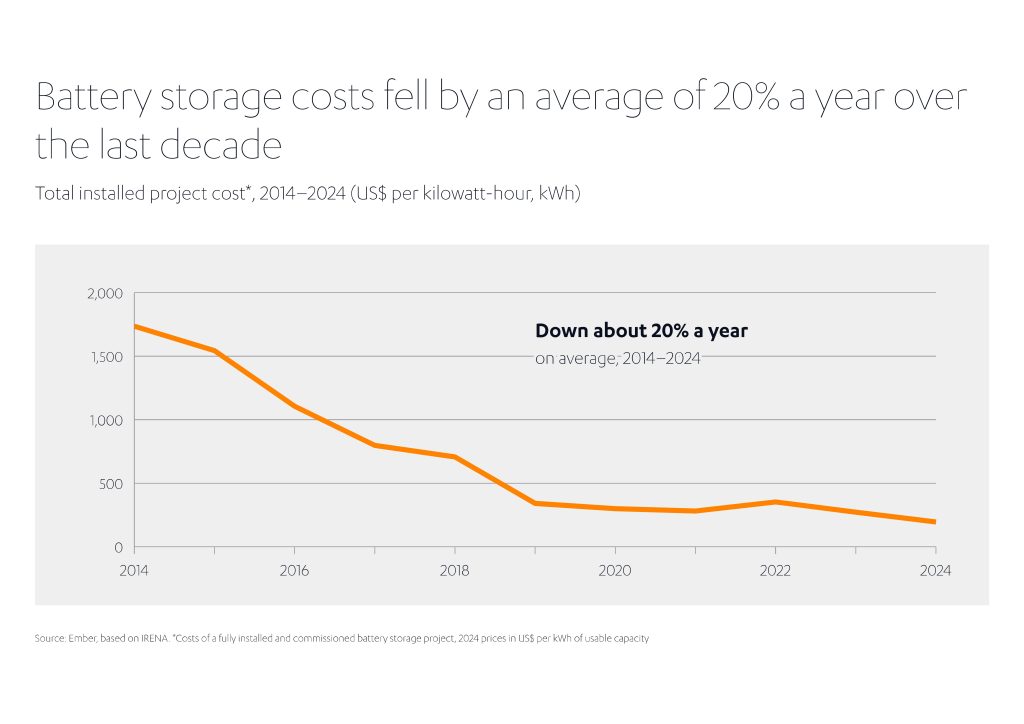
The cost of battery storage projects is falling rapidly amid increasing manufacturer competition, improved designs and lower pack prices. According to Bloomberg NEF data, in 2025 the global benchmark cost of a four-hour battery project dropped by 27% year-on-year to a record low (US$ 78 per MWh). This follows a decade of substantially decreasing prices, with installed costs falling around 20% a year on average between 2004 and 2014[9].
Policy
Government policies are a significant factor accelerating the growth of BESS, too. Net zero targets support widespread electrification, increasing demand on grids and driving the switch to renewables. Meanwhile, many governments have designed regulations or incentives specifically to support battery storage. In China, mandates to co-locate storage with renewable projects have underpinned much of the growth of BESS in recent years. These ended in 2025. In other countries (including Poland[10], Ireland[11] and Australia[12]) there are subsidies or effective requirements for battery storage.
How are key countries around the world using battery storage?
China is the world leader in battery storage, accounting for more than half of global BESS capacity by the end of 2025[13]. To a large extent, this capacity is a result of policies designed to reduce en1ergy waste. Curtailment of wind energy in the country – when production is deliberately reduced due to an oversupply – reached a high of 17% in 2016[14]. The following year,Chinese provinces began to bring in co-location mandates, which became national policy for power generation projects from 2021. This helped keep curtailment low, as well as driving rapid BESS growth.[15]
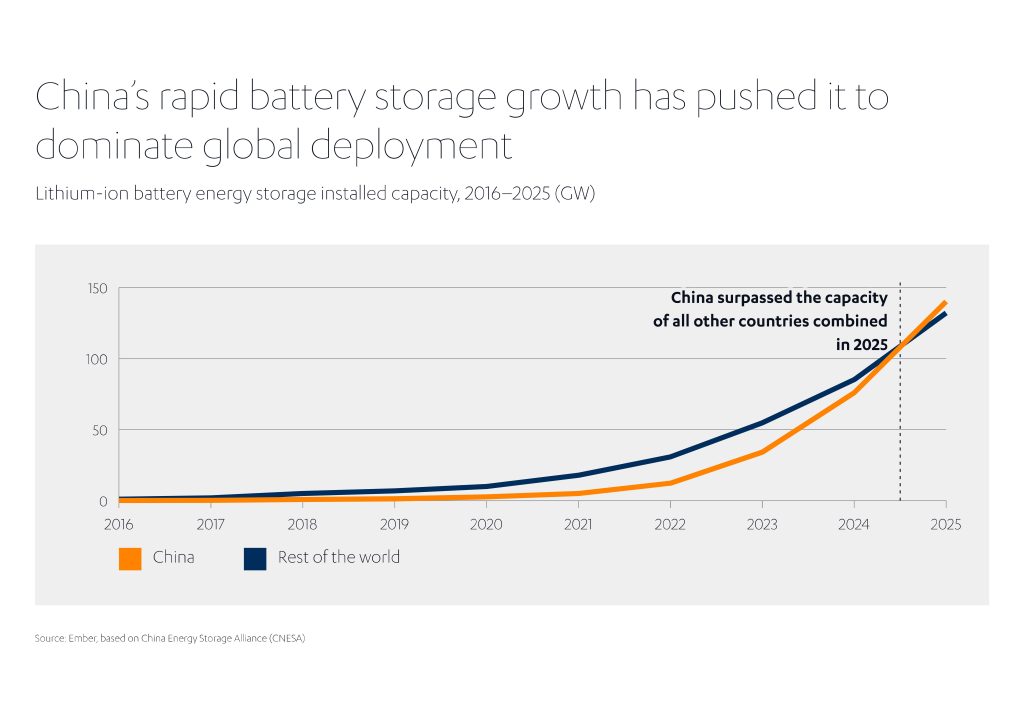
Much of this new storage capacity was underused, however, as although businesses had a strong incentive to build battery storage, they had far less motivation to use it effectively. In 2024, in the area served by China’s state grid corporation (80% of the country), the average system sat idle 91% of the time[16].
In this context, China is moving to a different phase. The emphasis is shifting from co-located BESS to more flexible standalone systems, which are not tied to a particular plant. This is driven by two policy changes:
- In February 2025, ending the co-location mandate[17]
- In January 2026, extending the policy of capacity remuneration (where power plants are paid for availability rather than just generation) to standalone BESS[18]
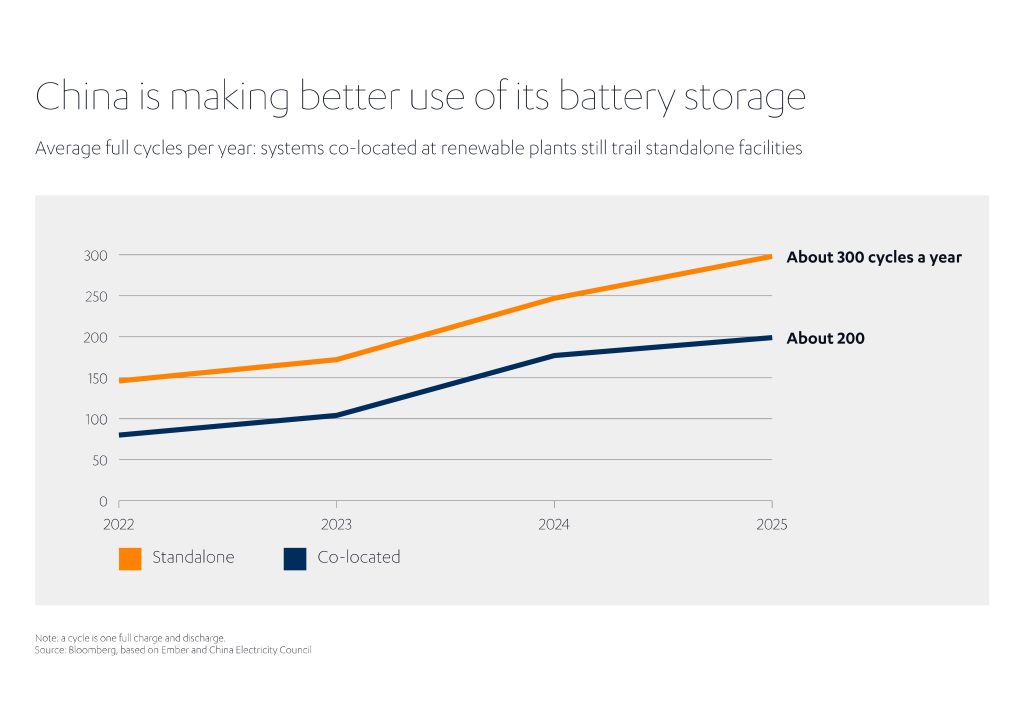
The results are striking: standalone storage has become the primary market driver, comprising 84.7% of new installed capacity between January and April 2026, with co-located systems accounting for only 8.4%[19].
Standalone systems can earn revenue in multiple ways, including energy arbitrage (storing energy at times of lower prices and selling it when prices rise) and leasing capacity. Policies such as moving to more flexible market-based pricing are helping increase China’s utilization of both standalone and co-located storage and there is still plenty of room for improvement. Analysts say optimizing the use of both co-located and standalone battery storage in 2025 could have shifted an amount of energy equivalent to powering Singapore’s whole economy for five months[20].
Analysts say optimizing the use of both co-located and standalone battery storage in 2025 could have shifted an amount of energy equivalent to powering Singapore’s whole economy for five months
“China has built the world’s largest battery storage fleet in record time, but having the batteries is not the same as using them. The next phase of China’s storage story will be defined not by how many gigawatts are added, but by how well they can support the new power system,” said Siming Liu, group strategy senior manager at Trina Solar[21].
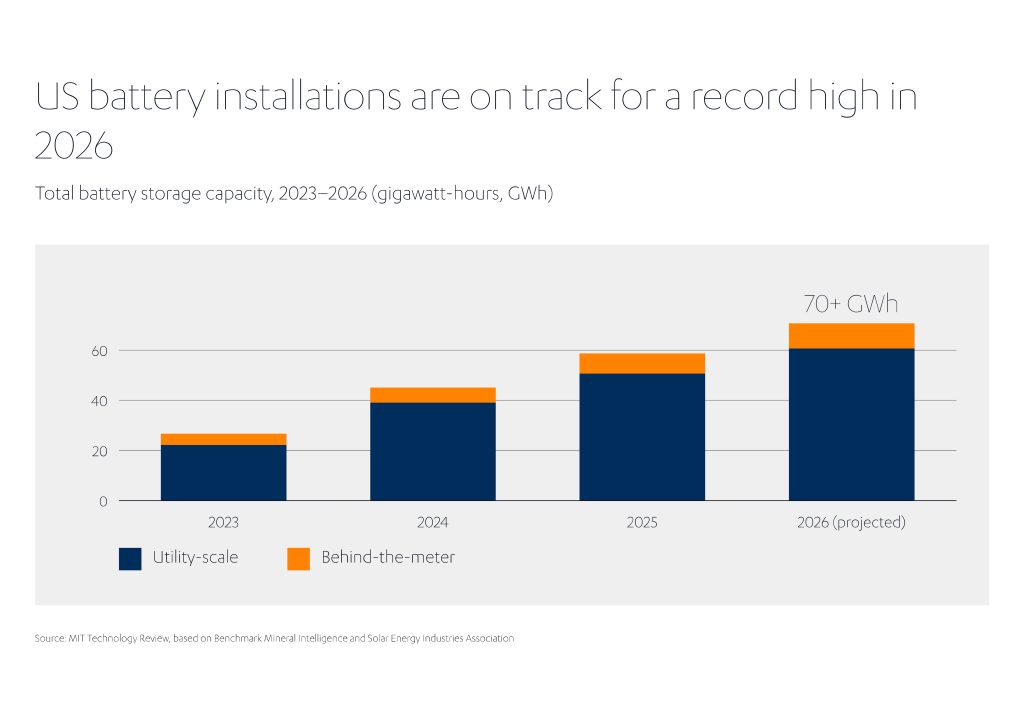
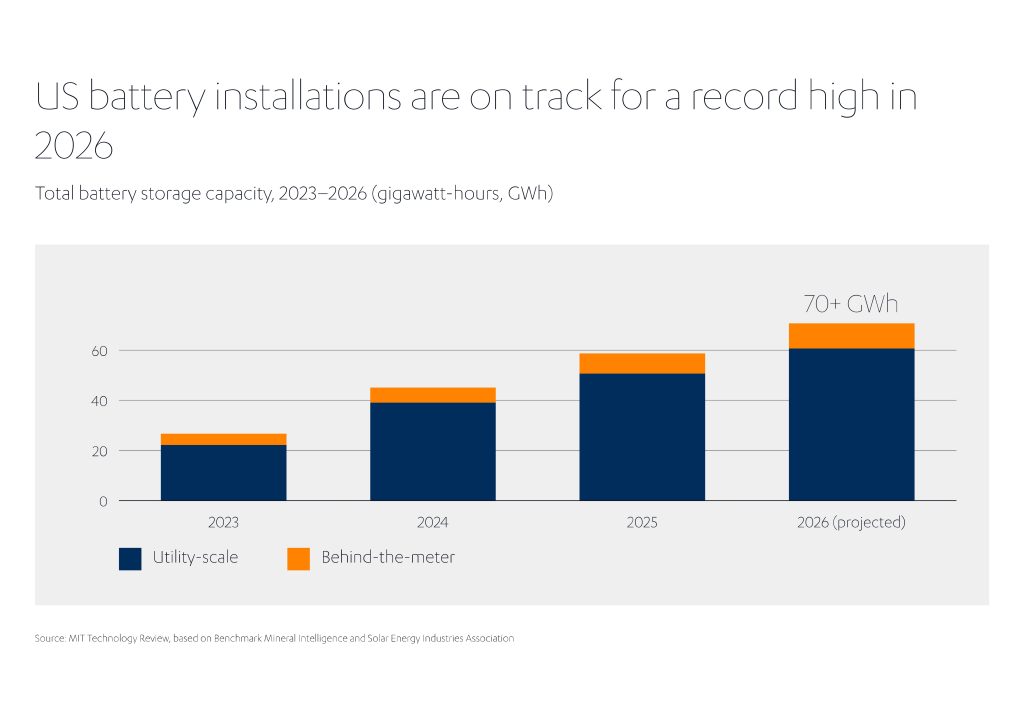
The United States is the world’s second-biggest battery storage market, and the sector is rapidly growing here too. In the second quarter of 2026, 20.2 GWh of new capacity came online – enough to meet the daily requirements of 700,000 homes. Most of the recent growth came from huge, utility-scale systems, with seven installations with a capacity over 1 GwH coming online in Q2 alone, and the country is on course to see a 20% increase in battery capacity in 2026[22].
The two US states with the biggest battery capacity are Texas and California and their growth illustrates how there’s no single best way to develop the sector. In California, capacity has grown rapidly from less than 700 MW in 2019 to more than 21 GW today[23], allowing the grid to store the abundant solar energy generated during the day for use at night. It’s estimated that the state’s batteries could power about a quarter of its peak demand.
As well as falling prices and grid reliability concerns, this expansion has been driven by regulation, including the US’s first energy storage mandate in 2013. Underlying these policy drivers is the state’s target of 100% clean electricity by 2045.
Meanwhile, Texas has become the fastest-growing battery storage market in the country with little direct policy intervention. Instead, increased demand (through population growth and data centers), as well as economic opportunities through energy arbitrage, are among the most significant factors. Texas’ low-regulation business environment, including fast permitting processes, and large amounts of land are also thought to have contributed to the growth.
While California and Texas lead the field, other parts of the US are now making serious progress
While California and Texas lead the field, other parts of the US are now making serious progress, too. In Q2 2026, Arizona saw 6.2 GWh of new installations – the largest in the country, and the strongest quarter for any state on record[24]. The continuation of federal investment tax credits for energy storage projects, even as those for wind and solar are phased out, is contributing to the sector’s strong growth.
While the US and China are the front-runners in global battery deployment, other countries are making rapid advances.
Australia is now the world’s third-largest utility-scale battery market globally, with 4.3 GW of large-scale battery capacity reaching financial close in 2025[25]. In terms of capacity relative to population, the country already has a clear lead, with more than 1 GWh per million people, compared to less than 400 MWh per million people in China and the US.[26]
With renewables forming 43% of Australia’s grid, battery storage is increasingly important to maintain resilience and balance supply with demand. Across the country’s National Electricity Market, average battery discharge in the first quarter of 2026 reached 359 MW, more than three times the level a year previously[27].
Australia’s states and national government both provide strategic and financial support for BESS. The 500 MW Collie BESS, which went online in February, was the third BESS delivered by Western Australia’s state-owned energy company, Synergy, in three years[28], while in June, the government’s Capacity Investment Scheme (a revenue underwriting initiative) backed 15 new BESS projects with a combined capacity of 4.2 GW, expected to unlock US$ 4.2 billion in private investment [29].
“Our Capacity Investment Scheme is turning Australia’s pipeline of clean energy projects into jobs in regional communities and cheaper, more reliable power for millions of homes. We’ve got the best sun and wind in the world, and we’re using our sovereign renewables, stored in batteries, to shield our grid from global energy volatility and to bring down [people’s] energy bills,” says Chris Bowen, Australian minister for climate change and energy[30].
Australia is also a key market for Fotowatio Renewable Ventures (FRV), part of Jameel Energy and the Canadian infrastructure fund OMERS.
In February 2026, FRV Australia’s Armidale East BESS project in New South Wales was awarded a Long Duration Storage Long-Term Energy Service Agreement (LTESA). The LTESA framework is a key pillar of the state’s strategy to accelerate the deployment of long-duration storage solutions that support the security, resilience, and decarbonization of the electricity system.
Located around 16 km east of Armidale, the project will deliver a total capacity of 315 MW, of which 157.5 MW will feature an 8-hour duration system contracted under LTESA, making it one of the most significant long-duration energy storage systems currently under development in the country.
FRV Australia continues to grow its integrated portfolio of generation and storage projects to help build a more resilient and sustainable grid
Armidale East is expected to become FRV Australia’s third BESS project in the country, along with the Terang (see box) and Gnarwarre plants currently under construction in Victoria. With this milestone, FRV Australia continues to grow its integrated portfolio of generation and storage projects to help build a more resilient and sustainable grid. The company now operates nine PV facilities across Australia and New Zealand, surpassing 1 GW of capacity.
In focus: the Terang BESS
FRV Australia is contributing to the growth of Australia’s battery storage capacity through ambitious projects such as the Terang BESS in Victoria. Construction of the site began in August 2024 and is now nearing completion, with the facility already connected to the grid and energised[1]. It will have a discharge capacity of 100 MW and a storage capacity of 200 MWh.
The Terang facility is one of FRV’s many global BESS projects. Also in Victoria will be the 250 MW Gnawarre BESS, which reached financial close in 2025. The Australian sites join dozens of other ongoing FRV BESS projects[1] in countries including Spain, Italy, Germany and the UK.
What are the potential barriers to scaling up battery storage?
Battery storage is a proven, affordable, technology. So, what’s the catch? Many challenges concern the surrounding infrastructure and policy rather than BESS technology itself. Key factors that could hamper its growth include:
Connection delays
The growth of BESS is leaving grids scrambling to catch up. Bloomberg reports that in the US, for example, storage projects are “piling up in interconnection queues” as utilities struggle to make the necessary upgrades to support them. Across the country, the median wait time for connecting energy storage projects has risen from a year and a half in 2015 to five years in 2025[31].
Safety concerns
The safety risks of battery storage were dramatically highlighted last year by a major fire at one of the world’s largest BESS plants – Moss Landing, California – which lasted for days and destroyed 75% of the facility[32]. The 300 MW plant experienced a thermal runaway, a self-heating reaction resulting in extremely high temperatures and the emission of toxic gases, that is very difficult to put out.
The incident focused attention on the safety of lithium-ion batteries, the standard technology for BESS facilities. The US Environmental Protection Agency says many communities have raised legitimate safety concerns[33], while in the UK lawmakers say the risks present “unique challenges”.[34]
Planning & permission
In many parts of the world, safety worries and other local concerns are creating hurdles and delays for BESS projects. Some US towns have established moratoriums on BESS, and the UK planning system frequently blocks or delays projects[35].
Elsewhere in Europe, regulatory frameworks change frequently and can vary across different regions, creating uncertainty for developers. One law firm working in the sector says that in Germany, regulatory uncertainty “complicates planning, increases compliance risk and can delay investment decisions”.[36]
Supply chain challenges
China plays a major role in the global battery supply chain at every stage, from mining to processing and manufacturing. Chinese companies, for instance, control 25% of the world’s lithium mining capacity. The country processes 90% of the world’s graphite, and in 2023 accounted for 74% of global battery pack and component exports[37]. Similarly, Chinese system integrators, who produce complete BESS systems, hold a 76% share of the global market.[38]
The country’s dominance has contributed to falling prices, but in the long-term, it can create dependency and unpredictability for BESS projects. Dealing with developments such as Beijing’s recent pause on approvals for battery storage manufacturing plants[39], or the US government’s ban on the import of power equipment from certain countries, becomes more challenging when the supply chain lacks diversity.
To meet the COP28 goal of tripling global renewable energy capacity by 2030 while maintaining energy security, energy storage needs to increase sixfold
What’s the future for battery storage?
Battery storage capacity is expected to grow substantially in the coming years. To meet the COP28 goal of tripling global renewable energy capacity by 2030 while maintaining energy security, energy storage needs to increase sixfold, says the IEA, with battery storage accounting for 90% of the growth[40]. This would require an increase in deployment of 25% a year. McKinsey projects a higher increase in installed capacity: 50% a year between 2022 and 2030[41].
Achieving this level of growth will require a focused approach from industries and governments, with crucial considerations including:
- Strategic policy. Overcoming bottlenecks in permission and connection requires clear regulation and strong leadership. The UK is one country that has recently reformed its connections pipeline to focus on “what’s needed, when it’s needed”, prioritizing “shovel-ready” projects[42]. US States such as California have measures to fast-track clean energy projects, replacing the need for various other permits.
- Industry optimization. The best-performing BESS developers have capital expenditures that are 40% better than average, according to McKinsey, with much of this advantage explained by better approaches to contracting, engineering, procurement and construction. Optimizing system designs, training staff and enhancing sourcing arrangements are all examples of approaches that can help improve processes and drive down costs.
- New technology. Future technological developments are likely to offer new ways to address challenges from safety risks to supply chain constraints. Sodium-ion batteries, for instance, have the potential to be a safer and cheaper alternative to current lithium-ion options. A Chinese company, CATL, recently unveiled the TENER sodium – claimed to be the world’s first real-world validated sodium-ion energy storage solution[43]. In the long term, such technology could reduce reliance on China due to sodium’s abundance.

As Fady Jameel, Vice Chairman, International, Abdul Latif Jameel, says, “the need for better battery energy storage systems is intense. Implementing BESS on the required scale will be a major challenge. But while this prospect is daunting, we can take heart from the imaginative, exciting ways that businesses and governments are responding. They know that the rewards of success – for those involved and the wider world – will be considerable.”
Five fast facts: the rise of battery storage
Q: How fast is battery storage growing?
A: Remarkably fast. The International Energy Agency (IEA) calls it the fastest-growing power technology today, with 108 GW added worldwide in 2025 – a 40% rise on the year before. Installed capacity has increased elevenfold in just five years.
Q: Why do we need so much of it?
A: Because the grid is changing. As solar and wind supply more of our power, storing energy for when the sun isn’t shining or the wind isn’t blowing becomes essential. Add surging demand from AI and electric vehicles, and storage becomes critical to keeping grids stable.
Q: Who’s leading the world in battery storage?
A: China, by a wide margin – it accounts for more than half of global capacity. The US is in second place, while Australia has become the third-largest utility-scale market and, per head of population, the global leader, with more than 1 GWh per million people.
Q: What’s holding back battery storage?
A: Many barriers are related to the systems and processes around implementation. In the US, the wait to connect a storage project has increased from 18 months in 2015 to five years today. Safety concerns are fueling local opposition and planning delays, and the supply chain is heavily concentrated in China, which creates uncertainty amid geopolitical tensions.
Q: Can the world build enough battery storage?
A: To meet the COP28 goal of tripling renewables by 2030, the IEA says energy storage must grow sixfold, with batteries providing 90% of that growth. It’s a daunting target – but with costs falling, new chemistries like sodium-ion emerging, and governments and industry mobilizing, it’s a challenge the sector is racing to meet.
[1] https://www.iea.org/reports/global-energy-review-2026/technology-battery-storage
[2] https://about.bnef.com/insights/clean-energy/energy-storage-enters-the-100-gigawatt-era-three-things-to-know/
[3] https://energyindustryreview.com/power/battery-storage-capacity-record-growth-and-trends-in-2026/
[4] https://about.bnef.com/insights/clean-energy/energy-storage-enters-the-100-gigawatt-era-three-things-to-know/
[5] https://www.iea.org/commentaries/battery-storage-is-scaling-up-and-taking-on-a-larger-system-role
[6] https://www.iea.org/commentaries/battery-storage-is-scaling-up-and-taking-on-a-larger-system-role
[7] https://www.reuters.com/sustainability/climate-energy/data-centres-drive-energy-storage-boom-cycle-next-five-years-ubs-says-2025-11-12/
[8] https://www.mckinsey.com/industries/industrials/our-insights/powering-the-future-strategies-for-battery-energy-storage-developers
[9] https://ember-energy.org/latest-insights/how-cheap-is-battery-storage/
[10] https://www.ess-news.com/2025/12/19/poland-allocates-subsidies-to-14-5-gwh-of-energy-storage-projects/
[11] https://www.arthurcox.com/knowledge/new-connection-policy-for-data-centres-in-ireland/
[12] https://www.dnv.com/article/global-battery-energy-storage-system-bess-trends-and-investment-drivers-across-key-regions/
[13] https://ember-energy.org/latest-insights/from-scale-to-system-navigating-the-next-phase-of-chinas-battery-storage/
[14] https://ember-energy.org/latest-insights/from-scale-to-system-navigating-the-next-phase-of-chinas-battery-storage/
[15] https://ember-energy.org/latest-insights/from-scale-to-system-navigating-the-next-phase-of-chinas-battery-storage/
[16] https://www.bloomberg.com/news/articles/2024-08-12/china-rapidly-expands-battery-fleet-but-needs-to-start-using-it
[17] https://ember-energy.org/latest-updates/chinas-batteries-move-beyond-capacity-scale-up-utility-scale-storage-could-have-shifted-23-twh-more-clean-power-in-2025/
[18] https://ember-energy.org/latest-insights/from-scale-to-system-navigating-the-next-phase-of-chinas-battery-storage/
[19] https://ember-energy.org/latest-updates/chinas-batteries-move-beyond-capacity-scale-up-utility-scale-storage-could-have-shifted-23-twh-more-clean-power-in-2025/
[20] https://ember-energy.org/latest-insights/from-scale-to-system-navigating-the-next-phase-of-chinas-battery-storage/
[21] https://ember-energy.org/latest-updates/chinas-batteries-move-beyond-capacity-scale-up-utility-scale-storage-could-have-shifted-23-twh-more-clean-power-in-2025/
[22] https://www.technologyreview.com/2026/09/09/1143680/batteries-us-record/
[23] https://www.energy.ca.gov/data-reports/energy-almanac/california-electricity-data/california-energy-storage-system-survey
[24] https://ktar.com/arizona-technology-news/battery-electric-storage-growth
[25] https://cleanenergycouncil.org.au/news-resources/clean-energy-australia-report-2026
[26] https://www.pv-magazine.com/2025/10/21/australia-becomes-worlds-third-largest-utility-battery-market/
[27] https://www.pacificgreen.com/articles/third-largest-battery-storage-market-world-what-australias-rise-means-developers-and/
[28] https://www.synergy.net.au/Our-energy/Projects/Big-Battery-Projects
[29] https://www.power-technology.com/news/australia-selects-15-bess-4-2gw/?cf-view
[30] https://minister.dcceew.gov.au/bowen/media-releases/joint-media-release-big-batteries-power-37-million-australian-households
[31] https://www.bloomberg.com/news/articles/2026-08-15/us-battery-storage-projects-stall-as-utilities-struggle-with-grid-upgrades
[32] https://elkhornslough.org/blog/moss-landing-battery-fire-fallout/
[33] https://www.epa.gov/electronics-batteries-management/battery-energy-storage-systems-main-considerations-safe
[34] https://hansard.parliament.uk/commons/2025-06-05/debates/69C88AD8-77F8-4F85-A934-2DA4AFCCB24B/BatteryEnergyStorageSitesSafetyRegulations
[35] https://www.solarpowerportal.co.uk/battery-storage/accelerating-uk-battery-storage-deployment-through-modern-safety-standards-and-smart-planning
[36] https://www.wfw.com/articles/exploring-europes-bess-boom/
[37] https://www.eia.gov/todayinenergy/detail.php?id=65305
[38] https://www.woodmac.com/press-releases/2026-bess-market-share-chinese-integrators-76-percent-global-dominance-2025/
[39] https://www.reuters.com/business/energy/china-pauses-approvals-battery-storage-manufacturing-projects-cailianshe-reports-2026-09-07/
[40] https://www.iea.org/reports/batteries-and-secure-energy-transitions/executive-summary
[41] https://www.mckinsey.com/industries/industrials/our-insights/powering-the-future-strategies-for-battery-energy-storage-developers
[42] https://www.neso.energy/industry-information/connections-reform/connections-reform-results



 Dubai, UAEAugust 25 , 2026